Lifestyle, Book Reviewer & Meal Plan do-er

Thursday, 17 November 2016

Crispy, Breaded Halloumi + Sweet Potato Fries


This dinner is a real treat. It's also a great vegetarian mid-week meal option; the halloumi is a wonderful meat alternative as it has a similar meaty texture and is also very filling.
The addition of the fried egg is very much needed - it the creaminess of the yolk works well with the crispy halloumi and the sweetness of the fries (omg I could eat a mountain of these!)


It's also a really quick meal - don't let the whole breading process put you off; it takes less than 5 minutes to do prepare. 
I would say the whole dinner takes about 40 mins with preparation included. 

You'll also see in the picture that I clearly couldn't help myself, as I have taken a bite out of one of the halloumi slices! 

Serves 2
Ingredients
3 large eggs
A small bowlful of plain flour
50g of panko breadcrumns
1 block of halloumi
2 sweet potatoes
Olive oil for drizzling

Method

1. Pre-heat the oven to 180 degrees. Cut the potatoes into wedges. Place in a baking trap, drizzle with oil and roast for 25 minutes, turning every so often.

2. Beat 1 egg and pour into a bowl. Pour the breadcrumbs also into a bowl.

3. Slice your halloumi into thick slices (you should get about 7). 

4. Dip the halloumi slices into the flour, then the egg and then the breadcrumbs, ensuring to coat evenly. 

5. When the fries have about 5 minutes left, heat a small amount of oil in a frying pan and fry the halloumi slices for about 3 minutes on each side, until golden brown. Serve on the plates.

6 In the last minute, in the same pan, fry the 2 eggs and serve next to the halloumi, along with the fries. Serve and enjoy!


How do you like your halloumi? What do you pair yours with?


CookBlogShare
Share:

Sunday, 13 November 2016

Who Beet the Sugar Cane?


Franz Karl Achard
Copyright: Wikepedia https://en.wikipedia.org/wiki/Franz_Karl_Achard

Franz Karl Achard was the man behind the project to find an alternative to sugar cane, by using beet sugar instead. 

Franz was a German, born in Berlin in 1753. Franz studied many subjects at the Royal Academy of Sciences, although his real passion was the refining of sugar, of which he became passionate about because of his Stepfather's interest in it. 

In 1747 he struck gold when he discovered that sugar beets contained sugar. He then decided to plant these sugar-bearing plants in the garden of his Manor house in Kaulsdorf in Berlin. Unfortunately, the Manor house burnt down. However, in 1796 he managed to perfect an industrial process of extraction of beet sugar. The Institut de France however did not care, and would not support him. He did find financial support in 1802 from the Prussian King Frederick William III. Franz used these funds to build a sugar factory in Silesia. 


King Frederick William III
Copyright: http://www.emersonkent.com/history_notes/frederick_william_iii.htm

The factory went on to produce over 400 tons of beet - a lot! Franz ran out of luck again when the factory was burnt down in 1806 by Napoleon's war. in 1810 he built a smaller version.

The sugar business was moving rapidly because of a sugar cane ban by Napoleon, meaning the increase of sugar beet in Germany. 

The English tried to bribe Franz with money, asking him to say his discoveries were a failure, but he refused. 

Sugar was no longer a luxury product and a lot of people were buying it. Franz also decided to teach people to grow beet themselves, and to increase the number of beet growers. 

After Franz's death in 1821, his businesses were kept alive by Matthias Christian Rabbethge, a German sugar beet grower. I'm sure he would be happy to hear the success of his discovery still live on!


Share:

Guinea Fowl with Celeriac and Rosemary


Last Sunday I had the pleasure of hosting my lovely friend Rachel (Rachel blogs too - you should check her out hereand her husband, for the weekend. Now I'm always the kind of host who subjects my friends to recipes I've never tried before - it's always an experiment over at my house! 

This time I decided to cook guinea fowl. I had never eaten, let alone cooked this type of bird. All I knew was that it was meant to taste like chicken but slightly more gamey. It turned out to taste EXACTLY like chicken, and since it's not a really expensive bird, would be a great alternative to a Sunday roast if you're getting bored of the usual chicken. 

I paired the guinea fowl with, again, a vegetable I'd never had: celeriac. Now celeriac is a strange one. Rachel and I discovered this when cutting it, that it smells so much like celery (I'm guessing it's from the family of celery?) but tastes NOTHING like it. I would happily say that it's one of my new fave veggies. It's a great alternative to potato as it's really similar, especially when you roast it in slices. 

So enough talking, here's what I did:

Notes: with the leftover guinea fowl meat, you can always make my tasty and warming, rustic veg and guinea fowl soup.

Ingredients
25g salted butter, slightly melted
1 medium guinea fowl
1 celeriac, peeled
2 garlic cloves
A handful of rosemary sprigs
200ml chicken stock
Salt and pepper

Method

1. Pre-heat the oven to 200 degrees/180 fan. 

2. Rub the slightly melted butter over the guinea fowl, ensuring you cover all areas. Season with salt and pepper.

3. Slice the peeled celeriac into thick, semi-circle slices. Place into a baking tray.

4. Make the stock (I just used half a stock cube) and pour over the celeriac. Use a garlic crusher to crush in the garlic and sprinkle over the rosemary sprigs. Mix all together. This technique is called boulangere - typically done with potatoes.


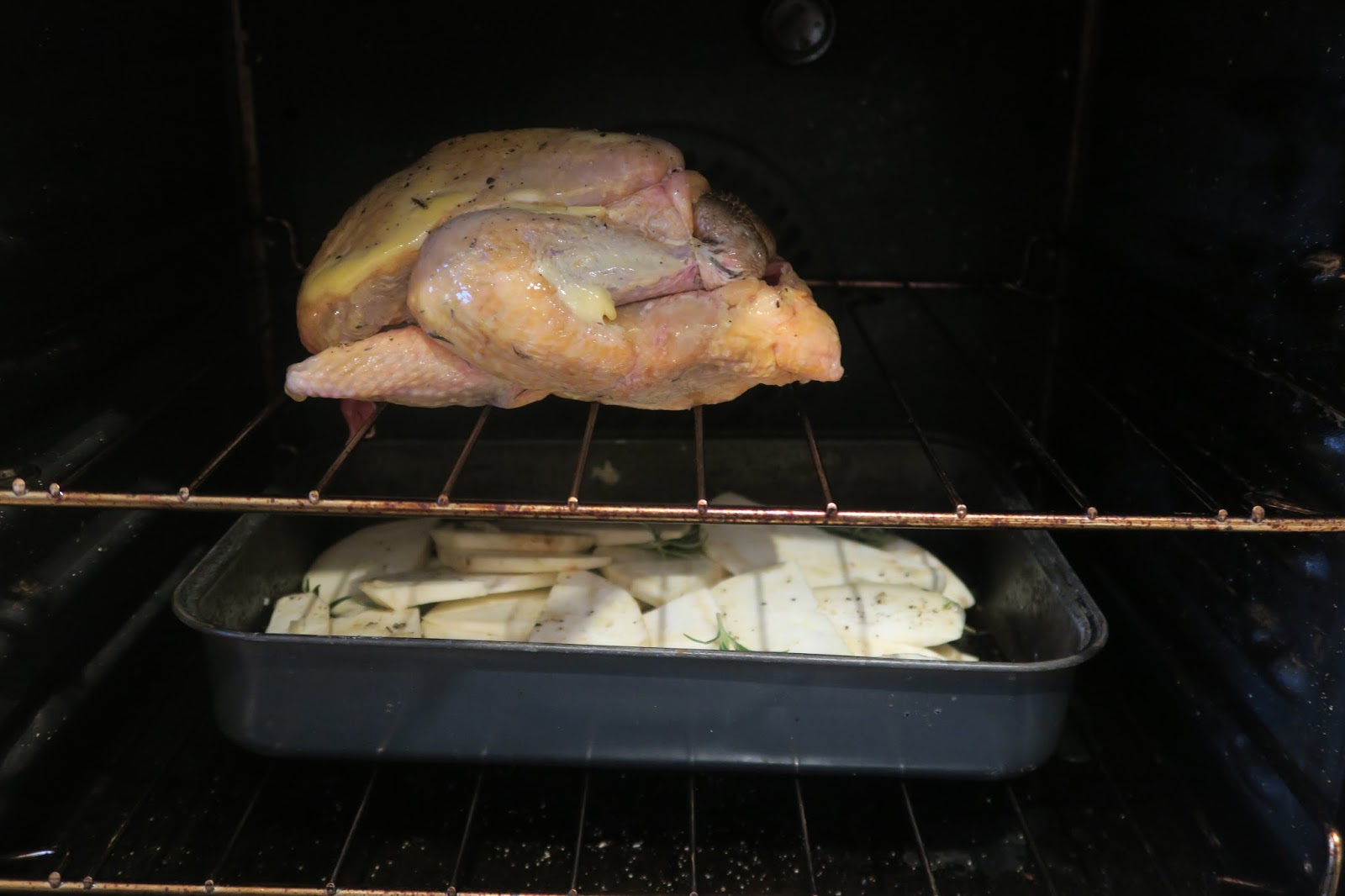
5. Put the celeriac on the bottom shelf of the oven and the guinea fowl on the top shelf, straight on the rack. This will slow the fat from the guinea fowl to drip onto the celeriac, creating a lovely gravy and caramelisation. Roast for 45-50 minutes. 


6. Once the guinea fowl is cooked through and juices run clear, remove from the oven. Allow to rest for 10 minutes. Allow the celeriac to roast for a further 30 minutes, until tender and slightly crispy on the edges. 

7. Once cooked, serve with the juices from the tray. I also served mine with roasted potatoes, in case my guests were not fans of celeriac! All-in-all though, everyone loved it! 


(I apologise for the poor quality photo - at this point we were so hungry, I just shoved the food onto the plate).

Have you ever tried guinea fowl or celeriac before? How do you cook yours?


Share:

Monday, 7 November 2016

How to Use your Leftover Pumpkin: Fondue


Okay, so now Halloween and Bonfire Night has passed, you're thinking - what shall I do with my leftover pumpkins? Well, that is the question I have been asking and have come up with a solution: Pumpkin Fondue. Serve this with roasted new potatoes and breadsticks, and you're in for an amazing, yet economical meal for two!

The Husband and I literally were fighting for the last pieces of cheese (there are three types in this fondue!) It's rich, warming and V. V fattening (just ignore that last part).

Don't be put off with the fact you have to chop and clean out your pumpkin. It's very simple; just read on to find out how...


Serves 2
 Ingredients
1 pumpkin 
Small potatoes, roasted
Enough breadsticks for two people

50g emmental cheese
50g gruyere cheese
50g mature cheddar cheese
1 tbsp cornflour
50g creme fraiche
1 tbsp white wine
50g shallot, chopped 
1 garlic clove, chopped

Method

1. Pre-heat oven to 180 degrees/160 fan/gas 4.

2. Prepare your roasted potatoes first. Prepare your pumpkin by cutting off a lid and scooping out the middle. Place on a baking tray and bake for 1 hour. 


3. Grate all 3 of your cheeses and mix with the cornflour. 

4. Remove your pumpkin from the oven and raise the temperature to 200c. In this order, place into the pumpkin: half cheese, creme fraiche, white wine, shallot, garlic and half cheese. 


5. Bake in the oven for 30 minutes. 

6. Once baked, serve the bubbling, cheesy fondue with your potatoes and breadsticks to dip in - bon appetit!


Do you have any recipe ideas for leftover pumpkins, rather than the obvious pumpkin soup? Would love to hear!


Share:

Sunday, 6 November 2016

Learning from Larousse: Abaisse


I think I'm going to make this a Sunday thing from now on.. although you know what i'm like when it comes to making statements like that! Anywho, just a quick post from me tonight as i'm currently waiting to get into my bath! 

This week's 'learning with Larousse' post is a French cooking term; 'abaisse' simply means to roll out a sheet of pastry. It can also be used for rolling out biscuits or even for a sponge cake when you spread a thin slice of jam on to it; anything that requires spreading.

The picture above is one that I took during my LCB days, when practising making pastry for a tarte au citron - one of the exam dishes! Thank God that one never came up! If you wish to try this, why not make some delicious pastries this weekend?

Until next week...

Hope you have all enjoyed your Sunday; I had a lovely one, relaxing with our friends (Rachel Pattinson) who drove down from Cumbria - we visited Homesense, Wholefoods and Daylesford Organic Farm (probably some of my favourite places!)

Did you know this culinary term already? What other French terms do you know?


Share:

Thursday, 3 November 2016

Comforting Toffee Puddings


Toffee apples, sweets on Halloween; a lot of things around this season are based on foods favoured by a sweet-tooth! Last Sunday I made this delicious, gooey, sticky toffee pudding for my Dad as my parents were visiting, and this is his favourite pudding. It always has been! 

They are easy to bake and the sauce is simple too. I definitely recommend having some mini metal pudding moulds ready and a large baking tray, and also some baking paper too. You will need this to line your moulds before putting them in the baking tray to bake in the oven. 

I really hope you enjoy these puddings, as they are just perfect for a cold, winters eve; perhaps on Bonfire Night to impress your friends!

Serves 4
Ingredients

70g butter, softened
100g light muscovado sugar
1.5 eggs, beaten
87g self-raising flour

Sauce
37g light muscovado sugar
37g dark muscovado sugar
37g butter
75g double cream

Method

1. Pre-heat the oven to 200c/180c fan/gas 6. Lightly grease 4 mini metal pudding moulds. Cut out a round disc from the baking paper and place in the base of each mould. 

2. Now you need to start making the sauce; put the sugars and butter in a small saucepan and heat until melted. Add the cream and bring to a simmer. Stir constantly and cook for a few minutes. Divide between the four moulds and leave to cool.

3. Beat the butter, sugar, eggs and flour in a bowl until pale. I did mine with  wooden spoon, just to be old-fashioned, but you can use a mixer. Spoon the mixture into the moulds once the sauce is cool.


4. Place the moulds in the baking tray and pour cold water in the tray until it rises 1cm up the sides of the moulds. 

5. Bake in the oven for 25 minutes until well-risen and a skewer come out clean. Take the mould out of the oven and one at a time, pick one up and run a knife around the inside; place a plate on top and tip upside down to get the puddings out. The sauce will pour out ready to serve. Serve with ice cream or clotted cream.

What's your favourite steamed or baked pudding?


Share:

Tuesday, 1 November 2016

Easy Sausage, Apple and Potato Bake


The evenings are drawing in quickly, and I don't know about you, but all I want sometimes when I get home, is something quick and comforting. Recently I've been fitting in a lot of blog post bakes and unusual dinners, but this one felt not a lot of work at all - just throw it all in and leave it! Apart from the glaze that is, but it's not too much work - I think you can handle it!

You will notice that my ingredients look a bit lost in that pan. It's basically because I chose a too large of a pan. If you double the recipe it should be better for fitting in a large pan, or just reduce the size if doing my recipe.

Just one quick thing before I give you the details; OH EM GEE - the sage is SO nice in this recipe. It's crispy, and when eaten with the bitter and sweet onions and crispy potatoes, it becomes such a good combo. 


Ingredients

500g Red potatoes, sliced thickly
2 tbsp olive oil
6 chipolatas 
1 Apple
1 Onion, sliced
A handful of sage leaves

Glaze
200ml cider
1 tbsp wholegrain mustard
1 tbsp redcurrant jelly
2 sage leaves

Method

1. Pre-heat oven to 200c, 180c fan.

2. Place the potatoes in a baking tray with the olive oil drizzled over. Season and roast for 15 minutes.

3. Once roasted, add the sausages, apple, onion and sage and drizzle with some more oil and mix together until fully coated. Roast for 30 more minutes.

4. In the meantime, make the glaze by pouring all the ingredients in a pan and bringing to a simmer. Cook for 12 minutes until reduced slightly.

5. In the last 5 minutes of the roasting, pour the glaze over and cook. Serve.


I'm going to be linking this post up to Cook Blog Share; you should check it out - a great linky we use to share what we have been cooking. 

CookBlogShare
Share:
© Jess Cantoni | All rights reserved.
Blogger Template Designed by pipdig